Category: knee

  • When Should You See a Hip or Knee Replacement Surgeon in Mohali?

    When Should You See a Hip or Knee Replacement Surgeon in Mohali?

    Patient Guide
    Patient Guide · By Dr. Aditya K. Aggarwal · 6 min read

    When Should You See a Hip or Knee Replacement Surgeon in Mohali?

    Joint pain changes your world gradually, then all at once. What starts as a mild ache after a morning walk soon turns into a struggle to climb stairs, get up from a chair, or go for an evening walk at all. The pain, the stiffness, the sheer inconvenience of it — they take over, quietly, until you notice you’ve stopped doing things you used to enjoy.

    If severe arthritis or an old injury has brought you to this point, and you’re wondering what the next step should be, here’s where I’d start: for residents of the Tricity dealing with chronic joint degeneration, finding the right surgical expert is the real turning point toward getting your life back. Once conservative treatment — medication, physiotherapy — has stopped giving you the relief it once did, it’s time to consult an experienced Hip Replacement Surgeon in Mohali or Knee Replacement Surgeon in Mohali and actually understand your options.

    When Should You Seek Help From a Joint Specialist?

    Surgery should always be the last resort — only once the joint has genuinely deteriorated and the cartilage has broken down. That degeneration can happen for a few different reasons:

    • Osteoarthritis
    • Rheumatoid arthritis
    • Trauma or old injury

    You should think about seeing a joint replacement specialist if you’re dealing with:

    • Severe pain in the joint that’s present even at rest, or that wakes you at night.
    • Stiffness that doesn’t ease up over time.

    Some patients also notice swelling or tenderness when the joint moves, or a grinding, popping sensation (what we call crepitus) during movement. Joint deformity or visible leg bowing is usually a sign the disease has progressed further. And when a joint starts limiting your range of motion, or getting in the way of ordinary things — walking, driving, getting up from a chair — that’s usually the point where it’s worth a proper conversation rather than waiting it out.

    What to Expect From Joint Replacement Surgery Today

    Orthopaedics has changed a lot over the last decade, and that’s changed how surgery gets planned and performed too. Advances like CT scans and MRI now let a surgeon map out the procedure in far more detail before ever stepping into the OT.

    Advanced Hip Replacement

    A Total Hip Replacement (THR) relieves joint pain and restores function by surgically removing the damaged, worn-out surfaces of the hip and replacing them with medical-grade prosthetic components — rebuilding the normal ball-and-socket anatomy so the joint moves and bears weight the way it’s meant to.

    Advanced Knee Replacement

    Partial and Total Knee Replacements work the same way for the knee — relieving pain and restoring function by resurfacing the diseased, damaged articular surfaces with medical-grade implants. Lately, the emphasis in knee surgery has shifted toward preserving the joint’s normal kinematics during the procedure, so the surrounding ligaments stay undisturbed and the knee feels closer to natural once it’s healed.

    Choosing a specialist Hip Replacement Surgeon in Mohali or Knee Replacement Surgeon in Mohali means years of focused clinical experience across thousands of primary and revision procedures — and the skill to manage complex cases with:

    Customized Surgical Planning: determining the optimal alignment and implant size specific to your own anatomy, not a one-size-fits-all approach.

    Enhanced Recovery After Surgery (ERAS) protocols — an aggressive, multimodal approach to pain management, focused on getting you up and moving, assisted, on the very day of surgery.

    Extended Postoperative Rehabilitation: dedicated support through the early stages of recovery, to rebuild range of motion, strength and overall joint function.

    The right time to see a specialist isn’t when the pain is unbearable. It’s when it’s started limiting your life — that’s usually earlier than most patients think.

    Taking the Next Step Toward Pain-Free Mobility

    Joint discomfort affects far more than the joint itself — it affects your whole quality of life. If you or someone in your family has chronic hip or knee pain, it’s worth consulting a specialist sooner rather than later. There’s a full range of treatment options available, from joint-preservation techniques through to replacement surgery, and you deserve a clear understanding of all of them before deciding what’s right for you.

    To discuss your condition, go through your imaging, and talk through your options in detail, book a consultation with our team.

    Don’t let joint pain dictate your life. You deserve to move freely and be active again.

    FAQ
    How do I know if it’s time to see a hip or knee replacement surgeon?
    If pain and stiffness are present even at rest or at night, and medication or physiotherapy aren’t giving the relief they once did, that’s the point to consult a joint specialist — not necessarily to schedule surgery immediately, but to understand your actual options.
    Is robotic-assisted joint replacement available in Mohali?
    Yes. Dr. Aggarwal performs robotic and AI-assisted hip and knee replacement at Shalby Multi-Specialty Hospital, Mohali — patients from across Chandigarh, Panchkula and the wider Tricity don’t need to travel to a metro city for this.
    Does seeing a specialist always mean surgery?
    No. Surgery is the last resort, used once joint cartilage has genuinely deteriorated. A specialist will first look at joint-preservation options and conservative treatment before replacement is ever on the table.
    Dr. Aditya K. Aggarwal
    Dr. (Prof) Aditya K. Aggarwal
    Principal Director & Head, Orthopaedics and Joint Replacement, Shalby Multi-Specialty Hospital, Mohali. 75,000+ joint replacements, 35+ years, ex-Professor & Head, PGIMER Chandigarh. Full profile →
    Individual results vary by patient anatomy, diagnosis and overall health. This page is for general information and does not constitute medical advice; please consult Dr. Aggarwal directly for an assessment specific to your condition.

    Have Questions About Your Hip or Knee?

    Send Dr. Aggarwal’s team your X-ray or MRI on WhatsApp and get a straight answer on what it means.
    Book a Consultation
  • When is it Necessary to Approach an Orthopedic Surgeon for Your Knee Problems in Chandigarh?

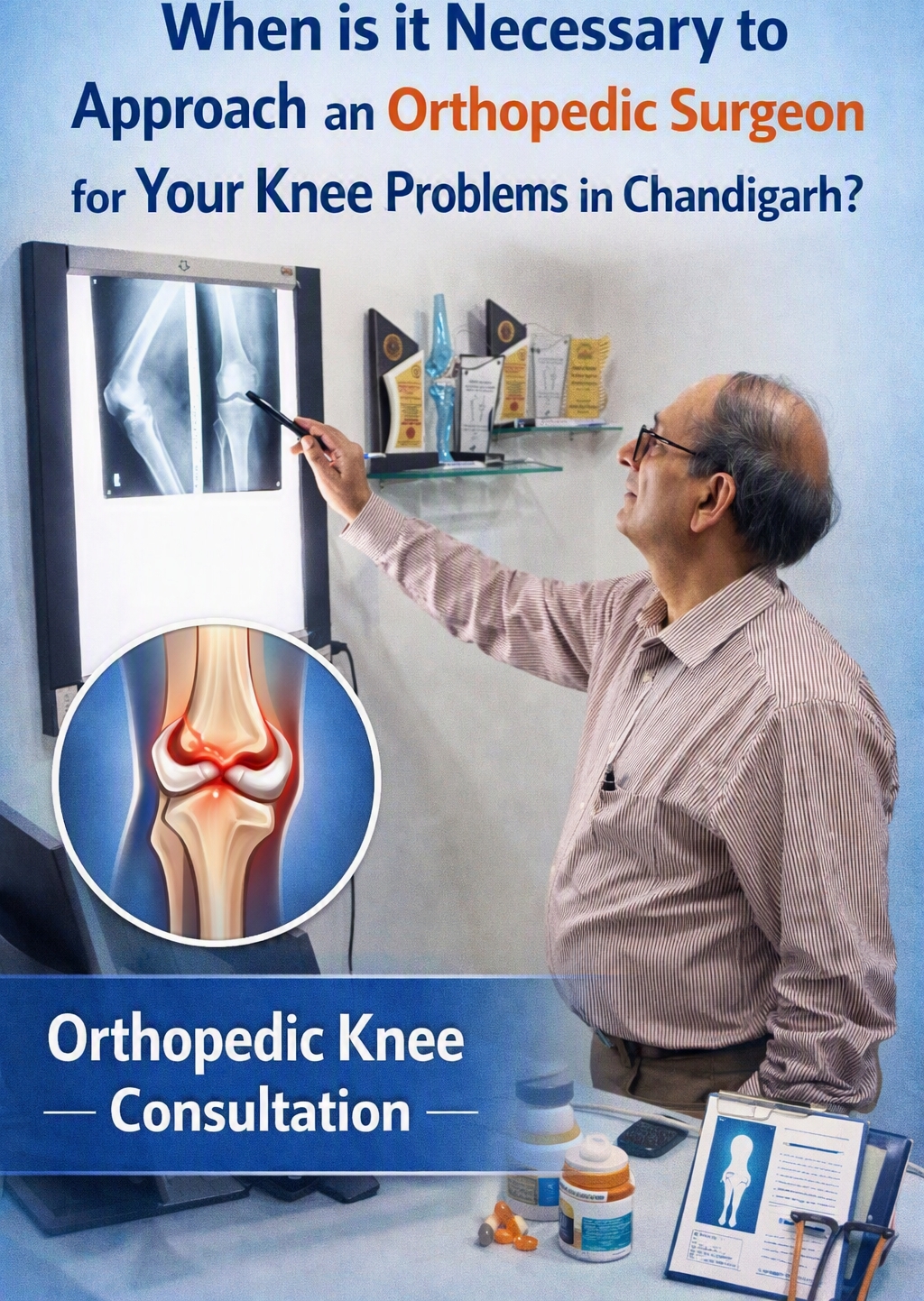
    When is it Necessary to Approach an Orthopedic Surgeon for Your Knee Problems in Chandigarh?

    Patient Guide
    Patient Guide · By Dr. Aditya K. Aggarwal · 6 min read

    When Is It Necessary to See an Orthopedic Surgeon for Knee Problems in Chandigarh?

    Pain in the knee is a condition which can happen to people of all ages. It can happen because of an injury, overuse, arthritis, lack of cartilage in the knee, or other conditions. Usually, pain in the knee can be treated by rest, and other minor methods. But if the pain doesn’t go away, and it starts affecting your work, then you should see an orthopedic surgeon.

    Recognizing the conditions and when to see a doctor will help you in identifying the problem and choosing the best available option for it. Finding the best orthopedic surgeon for knee in Chandigarh can be difficult. However, by identifying the conditions and available options for it, you can take the best steps for it.

    When to see an Orthopedic Surgeon?

    Only not seeing a specialist for knee problems is not the best option. You should see an orthopedic surgeon if the conditions get worse. Some conditions which force you to see an orthopedic surgeon are mentioned below.

    1. Persistent Knee Pain

    If you are not able to get relieved from pain by just rest for a long time.

    If you are not able to do normal activities like walking or climbing stairs.

    2. Difficulty Walking or Climbing Stairs

    Risk factors for reduced mobility include osteoarthritis, ligament and cartilage injuries and other conditions affecting the joints.

    3. Swelling and Stiffness

    Repeated knee swelling or stiffness can indicate an injury or condition such as arthritis.

    If swelling or stiffness does not resolve and causes an inability to fully straighten the leg, a medical professional should be seen to evaluate the cause.

    4. Knee Instability

    Knee instability or “giving way” is abnormal and may indicate an injury.

    Stress on an unstable knee may cause the ligaments to completely give way, resulting in a fall. Injuries may also be structural. An orthopedic surgeon can diagnose the injury and determine the next course of treatment which may include physical therapy, or surgery.

    5. Pain

    If pain is experienced after a knee injury, it is important to have the injury evaluated as there may be damage to the ligaments, tendons and meniscus. An ACL injury should be evaluated as soon as possible.

    A thorough examination of the injured knee may allow a medical professional to rule out other, less serious conditions.

    Conditions requiring a specialist

    A surgery to repair or replace the knee may be performed by an orthopedic surgeon.

    Osteoarthritis

    Osteoarthritis may be diagnosed and treated by an orthopedic surgeon. The breakdown of cartilage in the joints results in pain and a loss of mobility.

    Treatment may include pain management, anti-inflammatory medication and surgical intervention.

    Ligament Injuries

    Stability of the knee is provided by a number of ligaments. Injury to these ligaments may occur while participating in sports or in other medical/accidental conditions.

    Treatment of such injuries is individualized, taking into account the severity of the injury, the person’s age, level of physical activity and other factors.

    Meniscus Injuries

    The meniscus is a cartilage which acts as a cushion between the bones of the knee. It can get injured or torn during a sports injury or as a result of wear and tear.

    Injuries may also occur focally and in some cases may not require an invasive intervention.

    However, if symptoms do not improve, further treatment by surgery may be required.

    Knee Deformity

    Various conditions may cause the legs to be deformed and the knee to be out of its normal alignment. This may lead to difficulty in walking and may cause undue strain and stress to other parts of the leg and knee.

    In such cases, a doctor may advise an evaluation of the knee and leg to see if there is a deformity and to what extent. This may also help to decide the course of treatment.

    Advanced Joint Disease

    When knee pain becomes disabling and limits normal activities of daily living, it may be an indication for surgical removal of the knee joint (knee replacement).

    What to Expect From an Orthopedic Surgeon

    When you want to consult the top orthopedic doctor for knee in Chandigarh or any surrounding areas, it is useful to have an idea of what to expect during your first meeting with the surgeon.

    The surgeon will talk to you about your symptoms, conditions that affected your past health, surgeries and injuries, your general fitness level, and what kinds of activities you can do and what you enjoy doing.

    What are my treatment options?

    The conditions that affect the knee can range from minor to major and may require both surgical and non-surgical treatments. Some of the non-surgical treatments may include:

    • Physiotherapy
    • Use of special aids and braces
    • Weight loss if overweight
    • Certain medications
    • Injections
    • Modification of your daily activities

    The goal of treatment is to alleviate symptoms and improve movement of the knee. In the case where symptoms do not improve or if the knee condition is serious, then a surgical procedure may be required.

    When Is Knee Surgery Considered?

    Conditions that may require surgery include:

    • Major injuries or fractures affecting the knee
    • Degeneration of the knee joint (also called osteoarthritis)
    • Dislocation of the knee joint
    • Tear of the cartilage or meniscus

    Some of the surgical procedures that may be recommended to treat the above conditions include total or partial knee replacement, arthroscopy and ligament reconstructions.

    In the case where a total knee replacement is recommended, then the use of advanced surgical technology may be offered.

    How to Choose a Knee Specialist in Chandigarh

    When choosing a knee specialist in Chandigarh, consider the following:

    • Whether the specialist has experience treating your knee condition
    • Type of surgical treatment offered
    • Availability of diagnostic and imaging services
    • Range of treatments offered
    • Hospital services
    • Care offered before, during and after the surgery

    The doctor should be able to address all your concerns and give you treatment options.

    In the interim, there are a few things you may do to improve knee health including:

    • Loose or non-impact physical activities
    • Weight loss
    • Knee strengthening exercises
    • Modification of your daily activities

    Its important that patients injured or operated on a joint follow their physiotherapy and rehabilitation programs to aid their healing. Demanding activities should not be resumed prior to full healing.

    Conclusion

    Pain in the joints and other symptoms attributed to aging should not be ignored. Persisting symptoms of pain, swelling and stiffness could be indicative of an underlying condition and should be evaluated by a professional.

    Any symptom that causes disability or diminishes the overall quality of life merits further evaluation. Joint problems fall into this category. An orthopedic specialist, through his/her training and experience, assesses and diagnoses knee problems and design appropriate management strategies. Patients who desire an honest assessment by the ‘Robotic Knee Replacement Surgeon in Mohali‘ should schedule an appointment. A complete assessment will give patients an insight into the existing condition, and management options which may range from conservative care to surgical interventions including knee joint replacement.

    Dr. Aditya K. Aggarwal
    Dr. (Prof) Aditya K. Aggarwal
    Principal Director & Head, Orthopaedics and Joint Replacement, Shalby Multi-Specialty Hospital, Mohali. 75,000+ joint replacements, 35+ years, ex-Professor & Head, PGIMER Chandigarh. Full profile →
    Individual results vary by patient anatomy, diagnosis and overall health. This page is for general information and does not constitute medical advice; please consult Dr. Aggarwal directly for an assessment specific to your condition.

    Have Questions About Your Knee?

    Send Dr. Aggarwal’s team your X-ray or MRI on WhatsApp and get a straight answer on what it means.

    Book a Consultation